New Let’s Worship Series in 2nd Corinthians
5 Oct 2026 | Featured News
We've started a new series this week in our Let's Worship God booklets. What are these booklets? They have a Bible reading passage, notes written…


Dear congregation,
Whether we look at the big picture through a telescope or the small picture through a microscope, we ‘see’ God’s invisible ‘eternal power and divine nature’ (Romans 1: 20-23). And, contrary to the expectations of so many, the unexpected and astonishing level of inherent complexity and finely tuned intricacy makes the case for that eternal power and Godhead increasingly compelling. Science is increasingly making the case for theism – not that it needed to be made.
Tempting as it is to discover the astonishing activity and order revealed by the microscope on the micro level, we will confine ourselves for the moment to the macro level and to the James Webb Space Telescope, launched on Christmas day in 2021 and arriving at its destination one month later – nearly a million miles from the earth.
Its discoveries have surprised materialistic evolutionists – but not creationists. Particularly, it has further challenged the supposedly unchallengeable model of the big bang.
Most of us will be familiar with the fundamental postulate of the theory – which is that, around 14 billion years ago, a single atom of incomprehensible density (wherever it came from and however it came to exist in that particular form) exploded to ‘create’ the universe in which we live today.
The resultant matter from the exploding atom was, supposedly, just hydrogen and helium, with lithium traces, which, over many billions of years (and billions are required), condensed to form stars and galaxies. Heavier elements, including oxygen, nitrogen and carbon were believed to have formed many more millions of years later within the core of these stars.
However, just two years ago, the James Watt telescope detected a carbon cloud which was ‘dated’ to a mere 350 million years after the big bang – billions of years before carbon is supposed to have existed.
Again, it has also discovered a fully formed galaxy, glowing brightly with hydrogen and oxygen which, according to current timescales, must have formed less than a mere three hundred million years after the ‘big bang.’ This galaxy is also 1600 light years wide (that’s how far light travels in 1600 years) and has a mass of several million suns.
Naturalistic evolutionists are simply stumped as to how such a fully formed galaxy could be formed in such an astonishingly brief time. Read the rest of this blog post by Rev. Kenneth Stewart here.

We've started a new series this week in our Let's Worship God booklets. What are these booklets? They have a Bible reading passage, notes written…

A conventicle to mark the re-dedication of the monument to Rev John MacMillan in Dalserf churchyard South Lanarkshire (6 Kirk Rd, Dalserf, Larkhall ML9 3BL)…
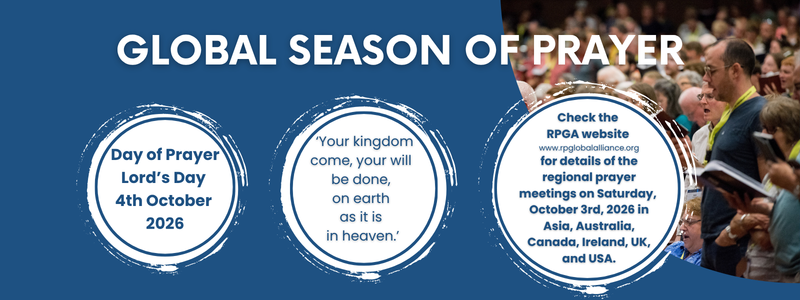
The Reformed Presbyterian Churches of North America, Ireland, Scotland and Australia have an annual joint Day of Prayer, usually in the autumn. It is a…